ArchivedYou are viewing MBABench 1.0 (Jun 2026). The current benchmark is MBABench 2.0.Go to MBABench 2.0 →

Inside MBABench 1.0

How MBABench 1.0 focused on industry standards when evaluating agent-built financial spreadsheets.

Rubric Examples

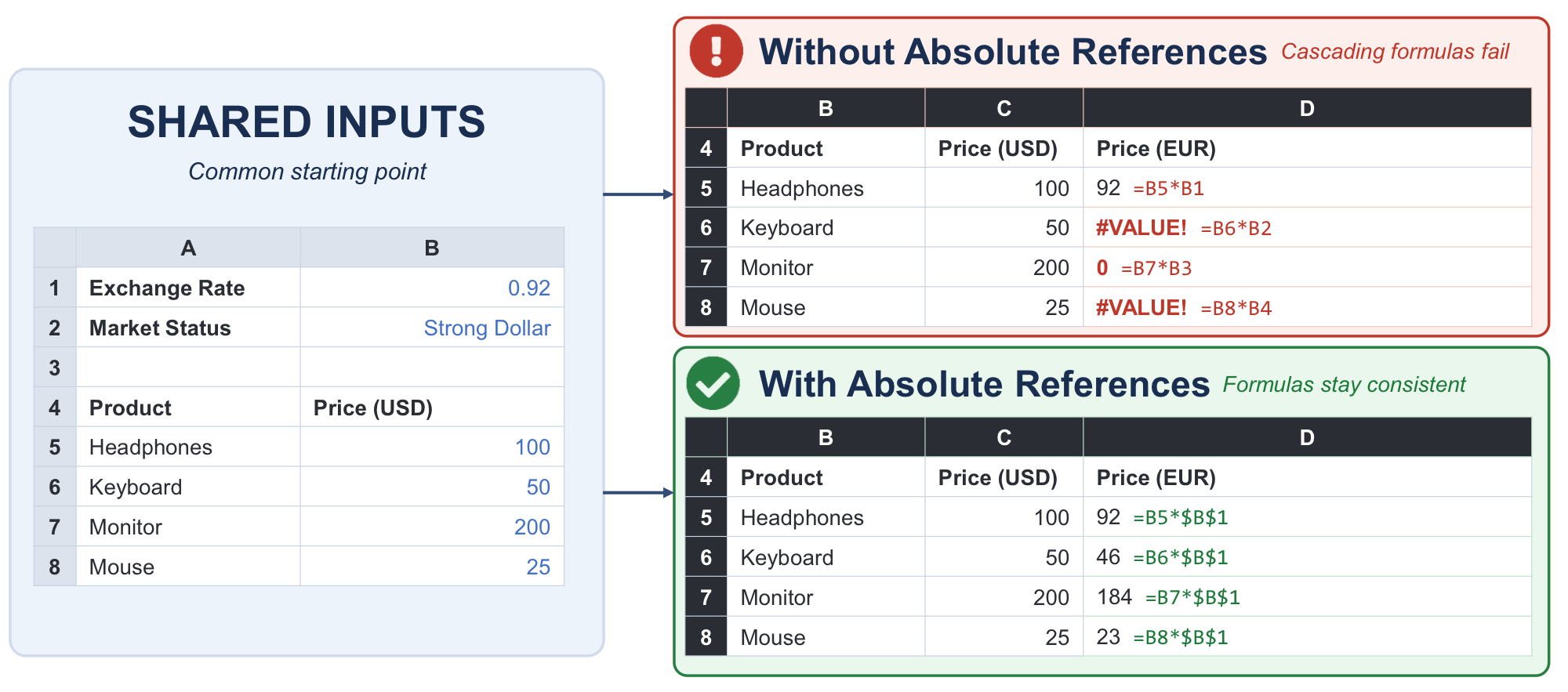
Several rubric subdimensions are best shown by example. Click any tab to see a failed example.

Formula
Format
absolute references

Task types

Tasks span a wide range of core financial workflows. The 3-statement model, the backbone of most financial modeling, is the most common. Expand any family to see its sub-types and description.

Sources

Where the tasks come from.

FMWC

Financial Modeling World Cup

A global, season-based competition that treats financial modeling as an e-sport. Competitors receive a raw Excel data file and a PDF case brief, then submit multiple-choice or exact-value answers from their model. Emphasizes dynamic modeling that must handle variable scenarios with flexible formulas.

ModelOff

ModelOff Competition

The original "financial modeling world championship"(2012-2019), now discontinued but still a gold standard for technical Excel competency. Format is similar to FMWC with more focus on traditional cases. Ground truths in our dataset are produced by competitors, not organizers.

WSP

Wall Street Prep

The leading provider of professional training for investment banking, private equity, and corporate finance. Tasks start from a partially-filled workbook with instructions written directly into the sheet. Highly structured and linear, relying on strict accounting identities and financial conventions.

Scale

Task statistics.

Each golden solution is a multi-sheet workbook, far larger than prior spreadsheet benchmarks.

Mean per taskMBABenchSpreadsheetBench
Cells58.3K1.8K
Function calls43,391680
Unique functions10.52.4
Sheets4.81.4

MBABench golden solutions have ~33x more cells and ~63x more function calls (mean) per task than SpreadsheetBench, the de facto standard for spreadsheet manipulation benchmark

Judge

How the judge grades.

The judge receives the evaluation rubric, a structured representation of the reference solution, and the agent's completed workbook. It returns a JSON consisting of pass or fail verdicts per criterion, and when failing, a explanation of where the attempt fell short.

{
  "Formulas": {
    "name": "Avoid hardcoding",
    "decision": "Fail",
    "mistakes": [{
      "description": "Hard-coded timeline headers.",
      "location": "Model!D64:AZ65",
      "explanation": "Year/Month headers are typed manually;
        should be computed from the Model Start Date input.",
      "expected": "Use YEAR(), MONTH(), DATE() to generate
        headers dynamically."
    }]
  }
}

The judge catches nuanced failures that exact-match-based verification would miss entirely. A few examples where the judge caught in actual agent attempts are shown below:

Off-by-one error in a rolling window

Computing LTM EBITDA requires aggregating four prior quarters. An agent used the wrong window, but since quarterly values were close, it coincidentally landed on the expected number. The judge flagged the logical error despite the same numerical result.

A workbook with hardcoded values

On a 1,000+ row trading simulation, an agent pasted numerically correct but externally computed results instead of writing formulas. The judge flagged the model as unauditable.

A freeze pane anchored too high

The freeze pane locked only title rows, letting the timeline headers scroll out of view. The judge diagnosed the problem in freeze pane location and prescribed the exact fix.