
The Science of Building Evals: A Practitioner's Guide to AI Benchmarks for Finance
TL;DR: The bridge from "AI is useful but untrustworthy" to informed adoption is an eval, a structured framework that tests AI output the way a senior analyst reviews a junior's work. This is the discipline of building one: the four components, the iterative process, and the hard-won lessons from building MBABench.
What Is an Eval?
An eval, short for evaluation, is a structured system for measuring how well an AI performs on a specific set of tasks. If you've ever graded an analyst's work against a checklist of quality standards (accuracy, formatting, modeling best practices), you've done something very close to building an eval. The difference is that an eval does it systematically, at scale, and produces results you can compare across different AI models, tools, and configurations.
In the machine learning world, evals are how researchers benchmark progress. But they matter just as much to practitioners. An eval answers the question every team eventually asks: is this AI tool actually good enough for the work we need it to do? Not in the abstract, but on your specific tasks, against your specific quality standards.
Why Evals Matter Now, Especially in Finance
There's a growing trust gap in finance when it comes to AI.
The numbers tell the story clearly. A 2025 Deloitte poll of over 3,300 finance professionals found that while over 80% believe AI tools will become standard within five years, only 13.5% are currently using AI agents in their workflows. A separate survey of 500 finance professionals found that 98% believe AI is important to their function and 61% can already quantify its ROI, yet 58% express concern about AI-related risks. The pattern is consistent: finance teams see AI's potential, but they're hesitant to scale adoption without stronger ways to verify that the output meets their standards.
This hesitation isn't irrational. Financial deliverables carry real consequences: a broken formula in a model can misstate a valuation, an inconsistent sign convention can mislead a deal committee, a poorly structured workbook can waste hours of a senior analyst's time. The math might be right. The deliverable isn't usable.
Most people stop at the conclusion: LLMs are useful but not trustworthy for financial modeling. That instinct is correct, but it's incomplete. The deeper problem is that we have no systematic way to measure where and how AI falls short. Without that, every conversation about AI adoption stays stuck in anecdotes.
The bridge from "useful but untrustworthy" to informed adoption is an eval, a structured evaluation framework that tests AI output the way a senior analyst reviews a junior's work. Not "did you get the right number?" but "could I hand this deliverable to a client?"
Building a good eval turns out to be its own discipline. This post walks through that discipline: the components, the process, and the hard-won lessons from actually doing it. We built an eval called MBABench that tests frontier models on 206 end-to-end financial spreadsheet tasks, and we'll draw on that experience throughout. But the framework is general: it applies whether you're evaluating LBO models, FP&A forecasts, or credit analyses.
Evals at 30,000 Feet
Strip everything away and an eval answers one question: how good is an AI agent at the work you'd otherwise hand to a person? For MBABench, that work is building financial models in Excel — an agent receives a case and a starting template, and produces a finished workbook.
The most reliable way to grade that workbook is also the most familiar one: put it in front of a human expert. A senior analyst opens the file, traces the formulas, checks the structure, and tells you whether they'd present it. That expert judgment is the gold standard — the north star every eval is trying to approximate.
The problem is scale. Our benchmark alone has 206 tasks, each drawn from financial modeling competitions where a skilled competitor spends hours on a single case. Now multiply: every task, times every AI agent you want to compare, times multiple runs per agent (agents are stochastic — they don't produce the same output twice). You're quickly looking at thousands of workbooks. No review team can grade that, and certainly not every quarter when a new model launches.
So the grading has to be automated — and automated grading exists on a spectrum of how close it gets to human judgment:
- Exact-match grading defines a golden answer and checks whether the output matches it precisely. Fine for a single number; useless for judging whether a workbook is well-built, since many different models can be equally correct.
- Similarity metrics (embedding distance, BLEU scores borrowed from machine translation) are easy to compute but unreliable — they can miss correct outputs phrased differently and reward plausible-sounding wrong ones.
- LLM-as-judge — a language model that reads the agent's workbook and grades it against an explicit rubric, the way a senior analyst grades against their internal standard — gets substantially closer to human judgment than rule-based approaches.
But using an LLM as the judge just relocates the trust question. You no longer have to trust the agent blindly — now you have to trust the judge. Why should you believe its grades?
You shouldn't — not until you've tested it. And that's the key insight that organizes the entire pipeline. Every trustworthy eval runs in two phases:
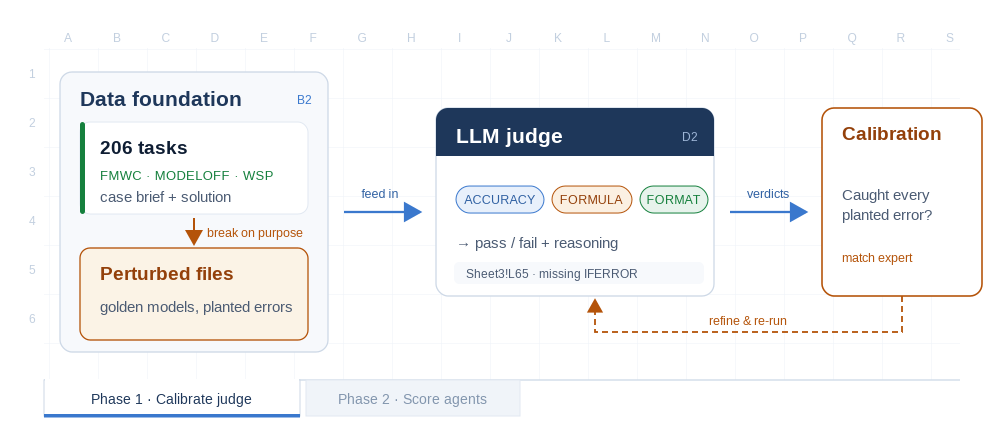
Phase 1 — Build a judge you can trust. Take near-perfect "golden" models, plant known errors in them, and check whether the judge catches every one. Refine the rubric and the judge's instructions until it does, then spot-check its grades against a human expert's on real AI outputs. Only when the judge's calls match the expert's do you lock it in.
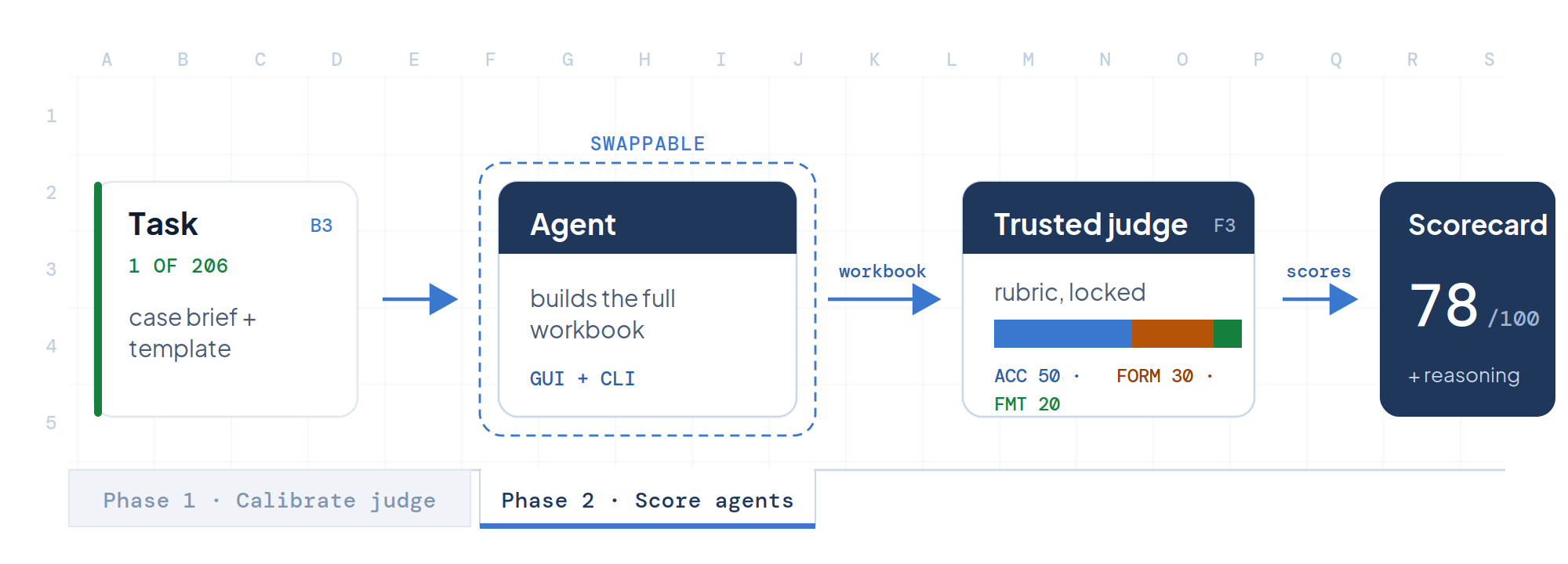
Phase 2 — Score agents at scale. With the judge calibrated, the assembly line opens: every agent attempts every task, every workbook flows through the same trusted judge, and out come comparable scorecards — a number you can rank agents by, plus cell-level qualitative reasoning that explains each grade.
Four components make these two phases work, and the rest of this post walks through each:
- Data Foundation: the tasks agents are tested on, the golden solutions that define quality, and the deliberately broken files used to stress-test the judge.
- Agent Architecture: the AI systems being evaluated — the model, the tools it uses to drive Excel, and the instructions that shape its behavior. This is what you're measuring.
- Judge Platform: the rubric that codifies your quality standard and the LLM that applies it. This is how you're measuring.
- Calibration Loop: the Phase 1 process of testing the judge against planted errors, cataloging its misses, refining, and re-running until its judgment is one you'd stake your reputation on. This is how you know the measurement is reliable.
Component 1: The Data Foundation
Every eval starts with the same question: what are you testing, and how do you know what "good" looks like?
Curate tasks that mirror real deliverables. The most common mistake is testing on toy problems — isolated formula checks, single-cell calculations, textbook exercises. These tell you almost nothing about whether an AI can produce a usable workbook. For MBABench, we sourced 206 tasks from real financial modeling competitions — the Financial Modeling World Cup (FMWC), ModelOff, and Wall Street Prep — where competitors at the MBA level typically spend hours on a single case. Each task has two parts: a case brief (a PDF laying out the scenario and assumptions) and a starting Excel template. The agent's job is exactly the competitor's job: build a complete, interconnected model in that template. If you're building an eval for your own firm, the deliverables your junior hires spend their first months learning are probably the right scope.
Build golden solutions as reference points. You need expert-created solutions that represent what quality looks like — near-perfect models a domain expert would be comfortable presenting. They aren't the only correct approach; they're the standard of care. They anchor the judge's evaluation without being a rigid answer key.
Then break things on purpose. Take your golden solutions and introduce targeted, documented errors — what we call perturbations. Hardcode a number inside a formula that should reference an input cell. Rename a clean Assumptions / Model / Output sheet structure to Sheet1 / Sheet2 / Sheet3. Strip the freeze panes from a 50-column time-series sheet. Flip a sign convention in the cost buildup. Remove an absolute reference so formulas corrupt when copied down.
These known-bad files serve one very specific purpose: they let you test your judge before you trust it. Because you planted every error yourself, you know exactly where each one lives — so you can measure whether the judge finds real mistakes and avoids hallucinating fake ones. Without this step, you're building an evaluation system you can't validate. The perturbed files are the answer key for grading the grader.
Component 2: The Agent Architecture
An "agent" in this context is an AI system that can take actions: not just answer questions, but actually open a spreadsheet, write formulas, format cells, and produce a finished workbook. Think of it as the difference between asking someone to explain how to build a DCF and asking them to actually build one. The agent is the one building it.
Every agent has three layers: the underlying AI model (GPT-4, Claude, Gemini, etc.), the tools it can use to interact with Excel, and the instructions that tell it what to do and how. A good eval needs to test across different combinations of these layers, because each one changes what you're measuring.
Different agents, different capabilities
In MBABench, we tested two fundamentally different types of agents.
The first is what's known as a CLI (command-line interface) agent. It interacts with Excel programmatically: reading cell values, writing formulas, and applying formatting through code commands, similar to how a developer might use a scripting language to automate spreadsheet work. It never "sees" the spreadsheet visually; it operates entirely through structured instructions.
The second is a GUI (graphical user interface) agent, built using browser automation tools like Playwright. It sees the spreadsheet on screen and uses mouse clicks and keyboard inputs the same way you would, navigating menus to insert formulas, adjusting column widths by dragging, selecting cells to apply formatting. It interacts with the spreadsheet the way a human does.
This distinction matters for eval design because each approach has different strengths and failure modes. A CLI agent might be precise with formulas but struggle with visual layout decisions. A GUI agent might handle formatting intuitively but make more errors when constructing complex cell references. If you only test one type, you're only seeing half the picture. The eval framework needs to accommodate both - same tasks, same rubric, different agents - so you can compare apples to apples.
The system prompt is the onboarding memo
Every agent gets a set of instructions, what the industry calls a "system prompt", before it starts working. This is the most underappreciated piece of eval design, because it directly shapes what you're measuring.
Think of it the way you'd think about onboarding a new analyst. You wouldn't hand someone a case study on day one and walk away. You'd tell them how the team structures its models, what naming conventions to follow, how to separate assumptions from calculations, when to use absolute references, what color coding standards to apply. The system prompt is that onboarding memo.
For MBABench, the agent's instructions include things like: analyze the case before building anything, separate your work into logical phases (calculations first, then formatting), use cell references instead of hardcoded values, label every calculation, create professional output sheets that link back to the model. These mirror the kind of guidance a manager would give, and testing whether the AI can follow them tells you something important about its readiness for professional work.
There's an important fairness dimension here: if the rubric holds agents to a standard that wasn't disclosed in the instructions, the evaluation isn't measuring capability — it's measuring mind-reading. For instance, if you grade on color-coding conventions but never told the agent what conventions to follow, a failing grade reflects missing instructions, not a failing model. Getting the instructions right is therefore as much about benchmark integrity as it is about agent performance.
Component 3: The Judge Platform
This is the core intellectual challenge of eval design. You're codifying what "good work" means in your domain, and building a system that can apply that definition consistently.
Mechanically, the judge is simple to describe: it's an LLM with two things layered on top. First, a prompt — instructions on what it's grading, what data it will receive, and how to report its findings. Second, a rubric — the explicit quality standard it grades against. Everything that makes the judge trustworthy lives in how carefully those two pieces are written, and in the calibration that follows.
Start with a rubric
A rubric is the bridge between tacit expertise ("I know a good model when I see one") and explicit, repeatable evaluation criteria. Designing one forces you to articulate what you actually value in a financial deliverable.
For spreadsheet-based financial models, we found that quality breaks down into dimensions, and each dimension breaks down into sub-dimensions: specific, checkable criteria that the judge evaluates independently. This hierarchy is what gives the rubric its precision. A dimension tells you what area of quality you're assessing; a sub-dimension tells you exactly what to look for within that area.
We use three core dimensions:
- Accuracy — Did the model get the right answers? Sub-dimensions include: whether final calculations match expected outputs, whether starting values are correct, whether the task is actually complete, and whether sign conventions (positive vs. negative) are consistent throughout. For example, the "Number sign consistency" sub-dimension checks that if CapEx is represented as negative in one section, it stays negative everywhere, and if costs are represented as positive, they're added when calculating total cost but subtracted when calculating revenue.
- Formula Quality — Is the model maintainable, not just correct? Sub-dimensions here include: "Logic readability & size" (are complex calculations split into helper columns, or buried in monolithic mega-formulas?), "Handle edge cases" (are there IFERROR wrappers where divisions could fail?), "Avoid hardcoding" (do formulas reference input cells, or are constants buried inside them?), "Range hygiene" (do data ranges expand dynamically, or will the model break when someone adds a row?), and "Using absolute references" (are constant cells locked with $ so formulas don't corrupt when copied).
- Formatting — Does the workbook communicate effectively? Sub-dimensions include: workbook and sheet structure, readability (freeze panes, spacing, labels), use of industry color standards (blue font for inputs, black for formulas, green for cross-sheet links), number notation (thousand separators, parentheses for negatives), information alignment, consistency of styles across sheets, use of borders and shading, and presentation of outputs or summaries.
Each sub-dimension gets explicit "good" and "bad" descriptions — with concrete examples — that the judge uses as its evaluation criteria. Here's what that looks like for the "Avoid hardcoding" sub-dimension:
All inputs and constants reference input cells; no external calculations; no buried constants.
Hard-coded values in formulas; external/off-Excel calculations; buried constants.
And for "Range hygiene":
All data ranges use Excel Tables or dynamic formulas (OFFSET, INDEX/MATCH). Charts, pivot tables, and summary formulas automatically include new data. No entire column references.
Hardcoded static ranges throughout. Adding rows breaks formulas or excludes data. Requires constant manual range adjustments. Frequent entire-column references.
The precision of these descriptions directly determines the precision of your evaluations. Vague descriptions produce inconsistent judgments. Specific descriptions produce reliable ones. The figure below shows the full breakdown of the three dimensions into their sub-dimensions.
Why LLM-as-judge
There are several ways to build an automated evaluator: rule-based scripts, deterministic checks, human review panels. For financial model evaluation, using an LLM as the judge has distinct advantages:
- It handles judgment calls that rules can't capture. There's no regex for "is this formula logic readable?" There's no script that can tell you whether a workbook's structure makes sense for the task at hand. An LLM can reason about why a formula is fragile, not just whether it exists.
- It evaluates holistically. A rule-based system checks one thing at a time in isolation. An LLM-as-judge can consider the full context (the case brief, the assumptions, the workbook structure) and make calls that account for how different parts of the model relate to each other.
- It provides qualitative reasoning, not just scores. When the judge fails a check, it can explain why in natural language, pinpoint the exact cell, and suggest what the correct approach would be. This makes the judge's output auditable, so that a human reviewer can read the reasoning and agree or disagree, which is essential for the calibration loop.
- It scales across diverse tasks. The same judge framework, with the same rubric, can evaluate an LBO model and a customer lifetime value analysis. You don't need to write custom validation scripts for every task type.
Design the judge's output for auditability
A well-designed judge doesn't just output pass or fail. You want structured output that gives you everything you need to audit the evaluation: the decision, the specific cell locations where issues were found, a detailed explanation of the problem, and what the expected result should be.
Here's a real example where the judge evaluating whether a model handles edge cases properly:
{
  "check": "Handle edge cases",
  "decision": "Fail",
  "mistakes": [
    {
      "description": "Missing error handling for division by churn rate.",
      "location": "Sheet3!L65",
      "explanation": "The formula divides by a churn rate pulled from the assumptions sheet. If churn were set to 0, this produces a #DIV/0! error. An IFERROR wrapper is needed.",
      "expected": "=IFERROR(K65/J65, 0)"
    }
  ]
}
Designing for this level of detail upfront pays off enormously during calibration. When the judge gets something wrong — and it will — you need to be able to trace why it reached that conclusion. A black-box score gives you nothing to work with. Structured reasoning gives you a clear thread to pull.
Build a scoring mechanism
Beyond qualitative reasoning, the judge needs to produce a numerical score you can compare across agents and tasks. This means deciding how much each dimension and sub-dimension contributes to the overall score.
The weighting should reflect what matters most for your use case. For financial modeling, we weight the dimensions roughly as follows: Accuracy at ~50%, Formula Quality at ~30%, and Formatting at ~20%. The reasoning: a model that gets the wrong answer is fundamentally broken regardless of how clean it looks, so accuracy carries the heaviest weight. Formula quality comes next because maintainability and resilience determine whether the model is usable beyond the initial build. Formatting matters, but it's the most fixable dimension; a senior analyst can relabel tabs and apply color coding in minutes, but they can't easily restructure hardcoded formulas.
Within each dimension, sub-dimensions contribute to the dimension score based on their pass/fail decisions. Not all sub-dimensions are weighted equally. For instance, within Formula Quality, "Avoid hardcoding" carries more weight than "Logic readability" because hardcoded values create silent errors that compound, while readability issues are more about efficiency than correctness.
These weights aren't universal. A firm that relies heavily on templates and client-facing deliverables might weight formatting higher. A team building internal models for quick analysis might weight it lower and emphasize accuracy and formula resilience. The key is that the weighting reflects your team's actual quality priorities, and that you revisit the weights during calibration once you see how they affect scores in practice.
Having a trusted final score matters for a practical reason: when you're choosing which AI model or agent to deploy for a specific type of task, you need a number you can compare. "Claude scored 78 on LBO tasks while GPT-4 scored 71" is actionable in a way that qualitative summaries alone aren't. But the score only becomes trustworthy after the calibration loop confirms that the judge's underlying pass/fail decisions are reliable, which is why we don't finalize scoring weights until the judge itself is calibrated.
Component 4: The Calibration Loop
Here's the part nobody talks about, and it's where most of the actual work lives. This is Phase 1 of the pipeline in action — the loop that turns an LLM with a rubric into a judge you can actually trust.
Your first rubric and judge setup will get maybe 60% of evaluations right. The remaining 40% will be a messy mix of false positives (flagging things that aren't wrong), false negatives (missing real errors), and judgment calls that are defensible but miscalibrated. This is completely normal. The calibration loop is how you turn 60% into something you'd stake your reputation on.
The process
Run your perturbed files through the judge first. This is why you created them. Since you know exactly where each error lives, you can systematically check: did the judge catch the hardcoded value in cell D14? Did it notice the missing absolute reference? Did it flag the generic Sheet1/Sheet2/Sheet3 naming? Run this across many perturbed files, not just one — the goal is to see the judge's behavior as a pattern, not an anecdote.
Catalog every failure. Track false positives and false negatives in a structured report. Patterns will emerge fast — the judge's systematic strengths and weaknesses — and they'll teach you things about your own rubric you didn't realize. Three examples from our experience:
- The judge hallucinated formatting errors. Early on, our judge claimed workbooks lacked freeze panes when the formatting metadata clearly showed them applied. The problem wasn't the judge's reasoning, it was our data pipeline. The judge was looking for freeze-pane indicators in the cell-level CSV data, but that information lived in a separate formatting section. The fix wasn't to the rubric; it was to the judge's instructions about where to look for each type of data. Lesson: when the judge gets something wrong, the root cause is often in how you present the data, not in the rubric itself.
- The judge applied rules without understanding context. Our rubric included a check for "range hygiene", whether data ranges are dynamic (using Tables, OFFSET, INDEX) so the model doesn't break when rows are added. Early on, the judge failed every model that used static ranges, even in cases where dynamic ranges genuinely weren't needed. For instance, a fixed 4-year projection timeline that would never expand. The rubric description said dynamic ranges were best practice, and the judge took that literally. We had to add explicit context about when dynamic ranges are truly required (time-series that grow, datasets that update) versus when static ranges are perfectly acceptable (fixed-period models, one-time analyses). Lesson: rubric descriptions that seem clear to you will be interpreted more literally than you expect. Give the judge enough context to know when a rule applies and when it doesn't.
- The judge missed subtle completeness errors. In one case, an AI model calculated customer lifetime value correctly at the per-unit level but omitted the cohort-level aggregation the case explicitly asked for. The judge passed accuracy because the numbers it could check were correct. We had to sharpen the "Task Completed" sub-dimension: the model must produce every output the case requests, not just intermediate calculations that happen to be right. Lesson: your rubric will have blind spots shaped by your own assumptions about what "obviously" gets checked. The calibration loop surfaces them.
Refine the rubric and scoring, then re-run. Update descriptions, adjust scoring weights, add nuance, then run the perturbed files again. Each cycle tightens alignment between the judge's calls and how a human expert would evaluate the same work. The scoring weights themselves get refined here too: you might discover that your initial weighting overpenalized formatting relative to accuracy, or that certain sub-dimensions need more granular scoring.
Then, sanity-check on real AI outputs. Once the judge reliably catches known errors in perturbed files, run a sample of actual AI-generated models through it — and grade the same sample with a human expert. The question is whether the two sets of grades line up: would the expert and the judge fail the same checks, for the same reasons? You don't need to review as many files as you did during perturbation testing — this is a sanity check, not a full audit. But it's the final gate. When the judge's evaluations feel defensible, consistent, and close to the expert's on work it has never seen before, you have a judge you can trust at scale.
This loop — perturb, judge, review, refine, repeat — is the unglamorous core of building a trustworthy eval. It's also the part that produces the deepest insight. Every false positive teaches you something your rubric underspecifies. Every false negative reveals an assumption you didn't know you were making.
And once the loop converges, Phase 2 becomes almost mechanical: every agent attempts all 206 tasks, every workbook flows through the trusted judge, and out come scores you can compare — which agent is strongest at which kind of task, and how each one stacks up in aggregate across the benchmark — along with qualitative analysis of every output explaining exactly where each agent succeeds and fails.
Why This Matters
The point of building an eval isn't to produce a leaderboard. It's to produce a codified quality standard that captures what your best people know intuitively and applies it consistently, at scale, every time.
That's what's been missing from the AI-in-finance conversation. Not better models, but better ways to know when the models are good enough. Evals are the stepping stone to AI adoption within firms.
And here's why this is urgent: models change constantly. New foundation models launch every few months. New agent frameworks and tool integrations appear even faster. The model your team tested last quarter may already be outdated. What doesn't change is your quality standard that your deliverables need to clear. A trustworthy eval pipeline lets you take any new model or agent, run it through the same rigorous evaluation, and get a reliable answer to the question that actually matters: is this good enough for our work?
Without that pipeline, every team is starting from scratch with every new model release, running ad-hoc tests, drawing conclusions from sample sizes of one, and making adoption decisions on vibes. With it, you have a durable infrastructure that turns the rapid pace of AI development from a source of confusion into a source of opportunity.
The framework — data foundation, agent architecture, judge platform, calibration loop — is domain-agnostic. You could apply it to your firm's specific deliverables, with your own quality standards, tomorrow. What makes it powerful in finance specifically is that financial work has high standards and tacit knowledge: everyone knows what a good model looks like, but nobody has written it down in a way a machine can apply. The rubric forces that translation, and the calibration loop tests whether the translation actually worked.
MBABench is our application of this framework — end-to-end tasks, holistic rubrics shaped by investment banking and finance practitioners, LLM-as-judge for nuanced assessment that rule-based systems can't handle. We've published our research paper detailing the methodology, model results, and the full rubric.
- 🔗 Read the paper: MBABench
- 📧 Reach out: Hongseok Namkoong (namkoong@gsb.columbia.edu), Daniel Guetta (guetta@gsb.columbia.edu)
If you're exploring how to evaluate AI for your team's workflows — or building your own eval — we'd like to hear from you. The rubric got better because of practitioners who helped shape it, and it'll keep improving with more perspectives from PE, banking, public markets, and corporate finance.
The question isn't whether AI will play a role in financial modeling. It's whether we'll have the evaluation infrastructure to deploy it responsibly. That starts with learning to build the right evals.